OpenAI has written a new policy proposal 'Industrial Policy for the Intelligence Age: Ideas to Keep People First.' They propose the creation of a Public Wealth Fund that will provide American citizens with an automatic public stake in AI companies and AI infrastructure even if they are not invested in the market. Returns from the fund would be distributed directly to citizens.
The most significant line for me is "direct distributions to specific populations." It sounds to me like they are planning their own form of self-directed global UBI. About half of Anth employees are also donating shares into this fund. They foresee a transformative future.
ANTHROPIC 🔥: Personal Finance feature on Claude is being prepared for the upcoming release (again)!
> Personal Finance will work through Plaid integration.
> Claude will be able to analyse user’s bank data and build various dashboards on top of it.
> During development, this feature was named as “Claude Money” but has been renamed in the latest update.
> Given the new onboarding screen and an addition of Plaid integration logic, there is a high chance we would hear about it relatively soon.
“Claude Monet” would indeed be an epic name for this.
Soon? 👀
We’re committing a portion of Anthropic’s shares to the Anthropic Public Benefit Fund, a new wholly owned entity dedicated entirely to the public benefit.
It will start off with 5% of our shares. For every 50% increase in the company’s value over a set baseline, we can contribute up to an extra 2%, subject to our board’s discretion.
In total, this means that roughly 20% of Anthropic’s shares are committed to the public good. Our co-founders have already pledged to donate 80% of their equity, and around half our employees are donating a portion of their equity as part of a donation matching program we’ve run since our founding.
In the post below, we share more details about our new fund.
anthropic.com/news/public-benefit-fund
OpenCode 目前正遭受持续的网络攻击,而在事件处理过程中,他们遇到了和 Hugging Face 一样的问题:他们用来防御的前沿模型开始拒绝协助对抗攻击 agent,因为分析这些攻击触发了安全护栏。
机器翻译·
dax@thdxr
yes that was a bit frustrating mid incident when trying to investigate. they did quite a bit and then started refusing
we got access to daybreak blue now so it's better
it’s been a dramatic couple of days, I didn’t expect the already clean essay to be read so widely. I've heard more interesting discussions about mechanistic interpretability – should we think mostly in features or mechanisms and the flow of data through them, how much do weak activations matter, how does scale change things, and lots of other questions – than I have in a long time and I’ve been happy to hear all the discussion!
a couple things on the essay itself. it didn't have enough citations, only ones for the basic story, since it was an "informal research essay and working hypothesis" rather than a paper, and other prior work around neurons were in the technical paper we're still finishing up. but it blew up, so I've added citations to the essay as well. I also want to thank @curttigges who did a lot of the language neuron research with me
finally, while there was quite a range of updates, from this being incremental and obvious to interpretability going from hopeless to fully solved, I want to try to be clear about roughly where I stand
I used to think neural networks would take some big cleaning step and then we could begin the ordinary natural science of mapping the parts and how they connect, watching data flow through, mapping circuits, and so on.
at various points, like late layers of early model organisms and most layers of language models years ago, this didn't really work. but now with better tools and better models of study, it works much better
for smaller vision models, this normal science process worked surprisingly well, until the whole map started to be broadly filled in. For bigger modern language models, it seems promising so far, for both neurons and circuits, attribution graphs, basically everywhere we've glanced. the map isn't filling in, there's a lot of map. there's still off-target firing, neurons that do a few things, but so far it's not an incoherent mess that you can't explore and learn from, and over time we get better at learning how to see it.
so maybe it keeps going, and mapping motifs and exploring actually gets you pretty far, maybe something like "all the way" to a reasonable solution. I don't think it would be so scientifically surprising if that were the case. everything in the neural network was built in some sense to be read – by its downstream readers – and if we can learn to look like a reader, we might find reading them relatively easy. many researchers I talk to outside interpretability assume the parts are already understandable, and the difficulty is just in the mapping stage!
it was also my prior when I first started looking at neurons when I first joined the field. there's lots of highly interpretable ones, maybe that's just how neural networks are if you look right.
even in the good world it would still take some iteration on tools, on ways of looking, neuron-attention interactions are tricky for instance. there's probably no bright red line separating "cleaning the model" from "learning to look better" but there's broad working principles, and as of now I think we should try to look relatively directly if we can
it shouldn't be so hard to test, you can just start looking at things and iterating and trying to understand motifs and such and see if it just breaks down at some point. it can take some iteration, I would recommend a bias against assuming arbitrary mixtures when you don't understand something at first, but also explanations should be tested
for now I'm pretty optimistic, and I'm glad there's excitement about interpretability, but too much can cause problems too. I think part might be that ai safety isn't a very hopeful field, and even moderate amounts of optimism about an important problem being solvable in the future fills a spot that has been malnourished for a while. across several safety disciplines, the researchers directly working on them are often more optimistic than the people broadcasting pessimism more broadly
for neural network interpretability at least, these are extraordinarily experimentally accessible objects of science, I don't know of a better one, and we have automated scientists. we have many things going in our favor. it's important and it's fun. the circuitry of these machines can be beautiful, surprising, entertaining, and insightful. I've spent thousands of hours looking through them, asking questions and running experiments and testing things, and would do so even if it weren't so important. I think the problem is solvable, whether the simple thing works, it mostly works but we need some new things, or we need big new ideas. I think we can figure it out
引用自博客:
“Claude 在优化经典算法方面已被证明尤为擅长,因此我们想看看,如果只给它每个电路必须计算什么的通俗语言描述,它是否也能对量子算法做到同样的事。
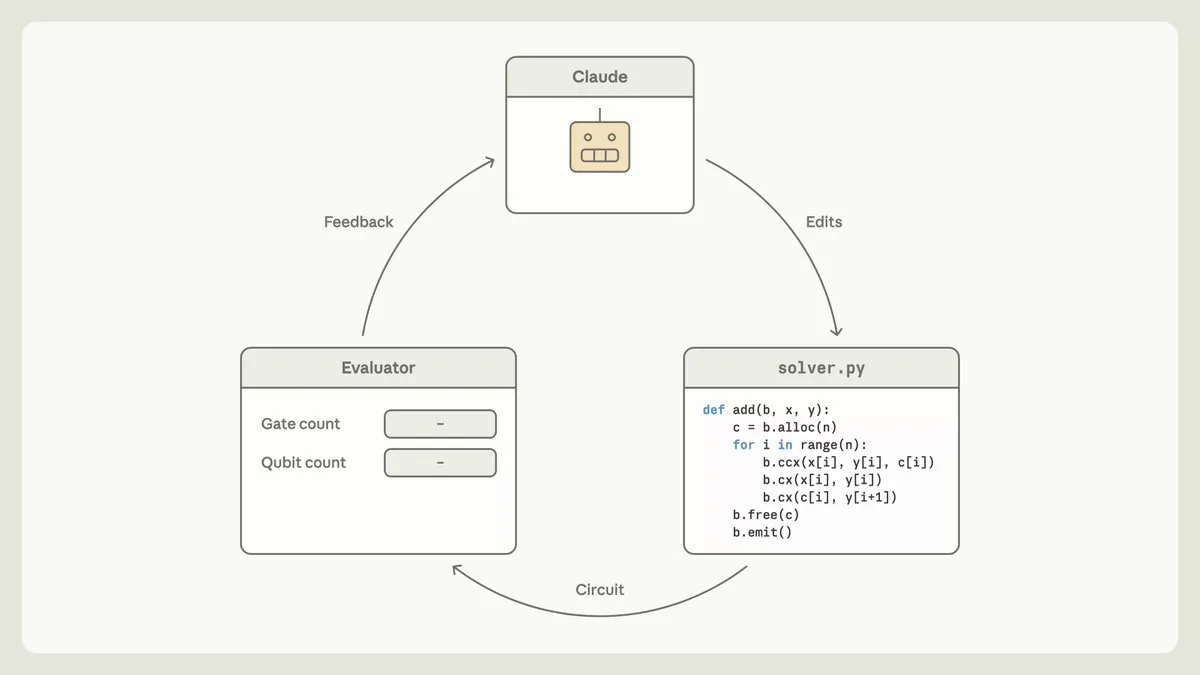
Claude 异常适合这项任务,原因有几个。首先,量子算法是以量子电路的形式实现的。这些电路由一系列门组成,比如上面提到的 Toffoli 门。重要的是,这些电路可以用代码来描述,因此我们可以利用 Claude 的编程能力,把电路设计当作普通程序来编写、运行和修改。其次,我们最想优化的那类(相当常见的)量子算法可以高效地检验正确性,因为每个输入都给出一个确定的输出,普通计算机就能检查。这意味着我们可以让一个外部评估程序来验证 Claude 的提案。最后,我们可以给 Claude 一个清晰、客观、可改进的分数:使用的量子比特数乘以门数,以此作为电路运行耗时的代理指标。
我们发现,Claude Mythos 5 能够成功地在一个闭环中工作:提出电路设计,从评估程序接收反馈和分数,并利用这些反馈改进下一次尝试,轮次之间无需任何人工输入。在八个计算原语——即更大量子算法所由构建的基本例程——上,涵盖化学、优化、量子模拟、数论和数值计算,Claude 发现了新颖的设计,其使用的量子比特数和门数都少于此前发表的最佳算法。”
New from our STEM Fellows Program: Designing more efficient quantum circuits with Claude.
Given plain-language instructions, Claude Mythos 5 designed quantum circuits that improve on the best published ones, sometimes by an order of magnitude or more.
More efficient circuits reduce the resources needed by quantum algorithms, which could bring quantum computing applications in chemistry and materials science within reach sooner.
Read more: anthropic.com/research/designing-efficient-quantum-circuits